Why Per-Square-Foot Averages Mislead on TI Work
Every national cost guide publishes an interior demolition range around $2 to $8 per square foot. On a tenant improvement job in San Francisco, Oakland, or the Peninsula, that range is a starting point at best.
The reason is that TI demo is rarely uniform across a floor. A 6,000 square foot suite might be 4,000 square feet of open plan that comes out fast and 2,000 square feet of built-out private offices, a server room with above-ceiling infrastructure, and a wet lab with a tile mortar bed. Applying one rate across the whole area either overcharges the easy portion or underwrites the hard portion, and on a fixed-price bid the second one is the expensive mistake.
A takeoff priced by assembly gives the general contractor something they can actually defend in a bid review, and it is why Servant King quotes from measured quantities rather than a blanket rate.
Selective Demolition Versus Soft Demo
Soft demo means everything non-structural comes out and the space returns to shell. It is fast, it is predictable, and it prices at the low end because nothing needs protecting.
Selective demolition means specific elements come out while adjacent finishes, systems, or structure stay and must survive undamaged. That requires hand work where a machine would be faster, temporary protection, and often a slower sequence coordinated around other trades. Selective demo on an occupied floor can price at several times the per-square-foot rate of the same area in soft demo.
When a scope narrative says "demo per plan" without distinguishing the two, the bid spread between contractors is usually explained entirely by which assumption each of them made.
Occupied Buildings, Night Work, and Schedule Cost
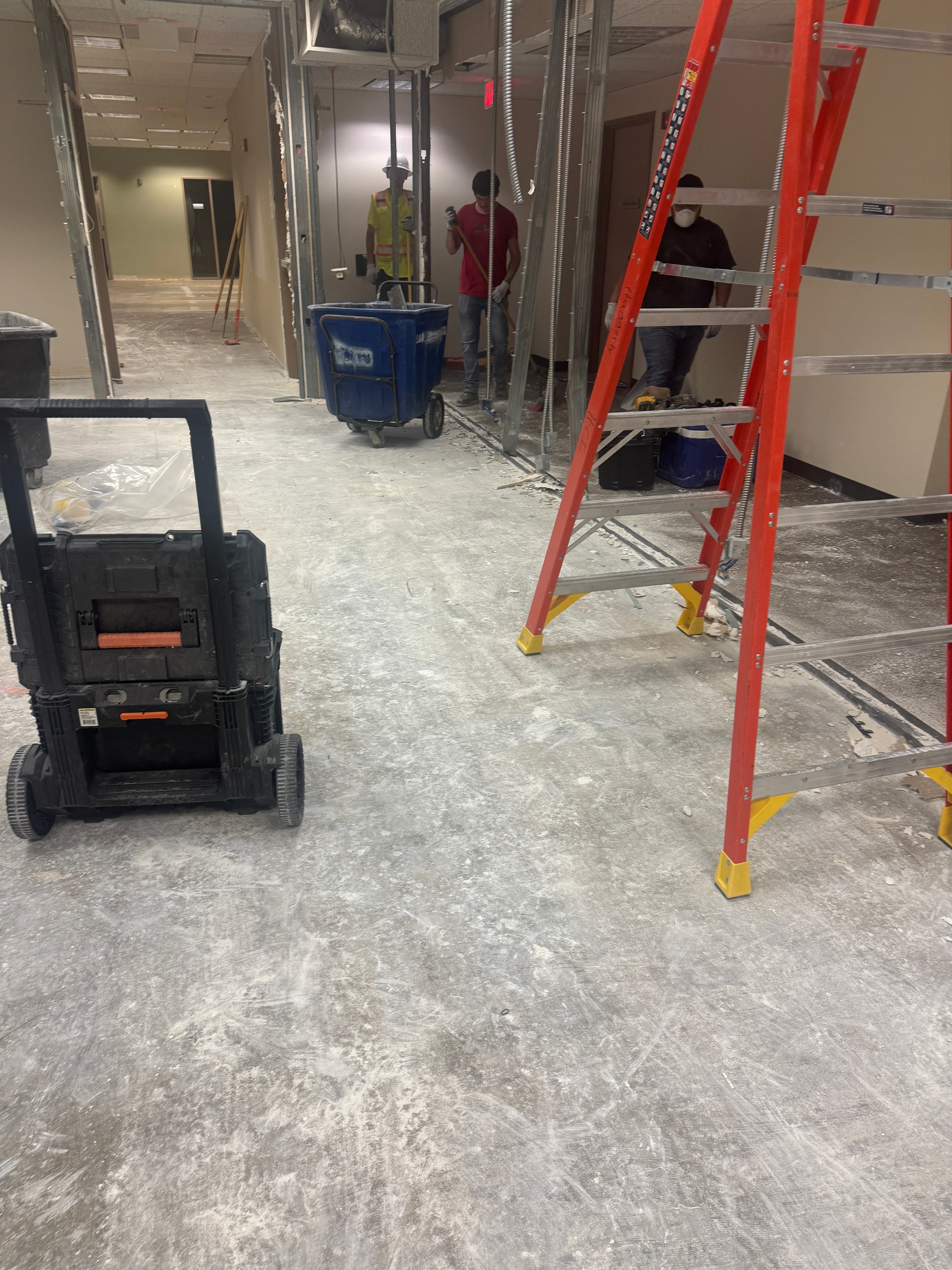
A substantial share of Bay Area TI demolition happens in buildings where other tenants are working. That drives requirements that show up directly in the price: after-hours or weekend labor, negative air and dust containment, noise restrictions during business hours, protected paths of travel, and loading dock windows measured in hours rather than days.
These are not markup. They are real sequencing constraints, and they are the reason a demo that would take three days in a vacant building takes eight in an occupied one. Getting building rules from the property manager before the bid goes in is the single highest-leverage thing a GC can do to keep demo numbers tight.
Disposal Routing Is a Cost Line, Not an Afterthought
On a full-floor TI demo, disposal can be one of the largest single line items. Two decisions control it: how well the debris is separated on site, and where each stream goes.
Metal separated on site and hauled to SIMS Vallejo returns scrap value rather than incurring a tipping fee. Clean wood, concrete, and mixed debris each have different cost-effective destinations, with Devlin Road Transfer Station in American Canyon among the routes used depending on the job site. Unsorted mixed debris hauled to the nearest facility is the most expensive possible outcome and is common on jobs where disposal was never estimated separately.
Bay Area transfer station rates run high enough that this is worth planning. For reference on the residential side, Contra Costa Transfer Station in Martinez runs roughly $126 per ton.
Licensing, Insurance, and Prevailing Wage
Servant King Demolition holds CSLB C-21 Demolition license #1142322 and carries insurance appropriate to commercial TI work. Public works and prevailing wage projects are handled with the required certified payroll.
For general contractors, the practical point is that license class and insurance limits should be confirmed at bid time rather than at contract execution, because a demo subcontractor who cannot be added to the project insurance is a schedule problem discovered at the worst moment.